
Brucenifica Leemanitas
“I swear to God he'd better not do that thing again where he just talks about a movie and shoehorns the Catholicism in halfway through.”
Today’s charity is Medicins Sans Frontieres/Doctors Without Borders. G.O.T.H.S. is free and any money you’d spend on reading one of my posts will be put to better use at a charity.
Maybe you’re already familiar with the 1978 film Game of Death, one of the most bizarre movies ever made and perhaps the ultimate document on how grotesque and soulless the film industry can be. I adore all of Bruce Lee’s movies, and while I acknowledge that this is his only film that isn’t “good” in the sense of “is this a competently made or even completed work of art”, I remain endlessly fascinated by this one. I’ve seen it, I’ve seen recuts, I’ve seen the weird sequel nobody has ever heard of, I’ve seen my favorite scenes clipped on a loop. If you don’t know this movie very well, you need to understand it in the context of Bruce Lee, the star of the film who died 5 years before the film came out.
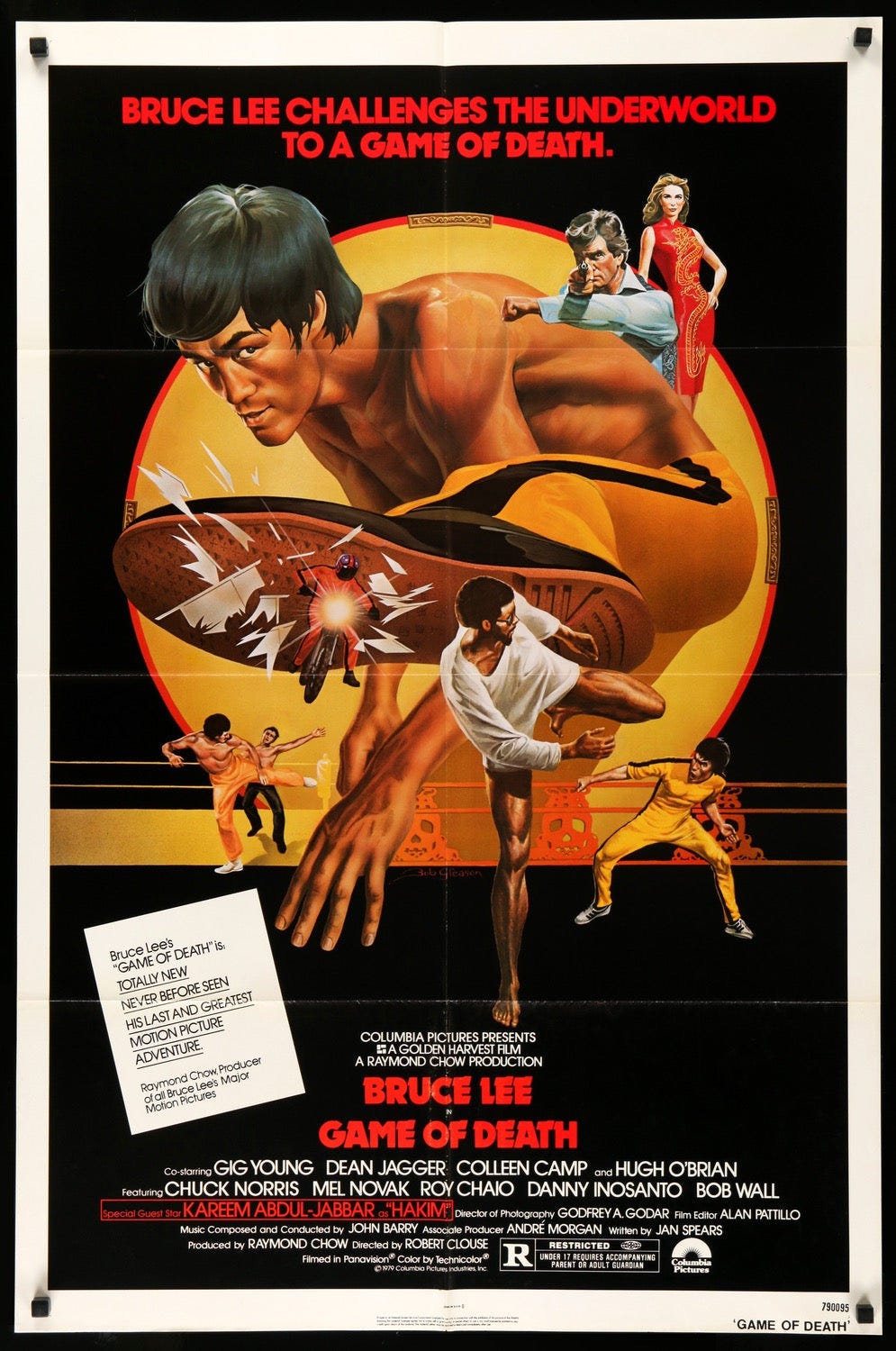
At the time of his death, Lee was the single biggest movie star in Chinese history, and he had just starred in Enter the Dragon, Hollywood’s first major attempt at bringing a kung fu movie to American audiences. Enter the Dragon was a massive hit, mainly because it was an insanely good movie and is a safe pick for “greatest kung fu movie of all time”; it became the highest-grossing film ever made for less than a million dollars, a record it held until literally this year when Obsession overtook it. Lee was absurdly charismatic and had tremendous screen presence, dubs of Lee’s earlier Chinese films were also becoming hits in the States, and it was clear that anything this guy touched was going to turn to gold. Great news: Lee was readying his second directorial outing, Game of Death. Bad news: he had to go ahead and die of a brain hemorrhage, leaving behind about 40 minutes of footage for an unfinished action film starring himself.
Imagine, for a moment, that you are a film producer who doesn’t give a shit about respecting Lee’s memory and just cares about making money. You have a dilemma: you desperately want to get Game of Death out there, but your bankable star can only be in a small slice of the film. Lee’s original footage was cut to about 12 minutes, but remains unbelievably sick to this day; Lee is wearing the iconic yellow-and-black jumpsuit that has been alluded to in films from Shaolin Soccer to Kill Bill, and he fights Kareem Abdul-Jabbar in one of the greatest fight scenes ever put on film. But you still need to fill in another 65-75 minutes leading up to that footage, without Bruce Lee. You can probably find an actor who looks a lot like Lee, but he won’t be able to fight. You can probably find an actor who can fight, but he won’t look a lot like Lee. You need to get the movie out to make a boatload of money, but it needs to be a full-length film. What do you do?
Whatever you answered to that question, Game of Death did it. Multiple body doubles filled in for Lee despite not really looking anything like him, so you have an 80-minute movie in which, for about 70 minutes, the main character is wearing a motorcycle helmet, or sunglasses, or a cheap fake beard because in this particular scene he’s supposed to be in disguise. There’s a plot point where Lee’s character has to get cosmetic surgery to disguise himself, so, you know, that’s why that actor doesn’t look like Bruce Lee, okay? Everything you would do if you were a halfway rational person trying to fill in a fake Bruce Lee for an incomplete Bruce Lee movie, the studio did.
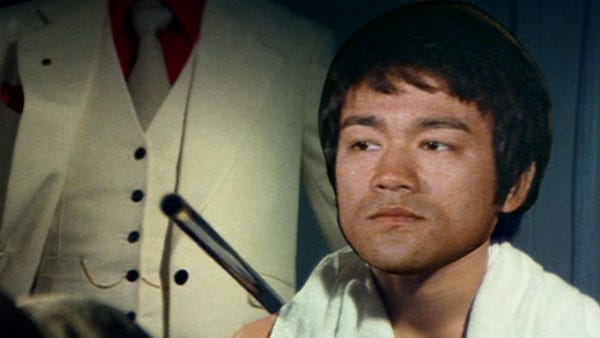
The problem is that the studio also did everything you would do if you were a completely insane person trying to fill in a fake Bruce Lee for an incomplete Bruce Lee movie. The entire climatic fight scene from Lee’s previous Chinese film The Way of the Dragon is just copy-pasted into the beginning of the film. It’s a great scene - Bruce Lee fights Chuck Norris in the Roman Coliseum! - but it’s literally in another movie. The climax of another Lee vehicle from his Hong Kong days, Fist of Fury, becomes a pivotal scene in the middle of this film; maybe you didn’t notice on the poster above, but there’s a callout touting the film as “TOTALLY NEW, NEVER BEFORE SEEN”, which is objectively false. Other scraps of the real Lee saying lines are just cut into the film to fill in dialogue, often with no regard for the continuity of the setting, costuming, or tone of the scene. Early in the film, Lee’s body double sits down in front of a mirror upon which is taped a cardboard cutout of Lee’s face, in an unbelievably low-rent attempt to convince the audience that Bruce Lee was in this scene:
When that character has to fake his death halfway through the film to escape the mob, the film uses footage of Lee’s actual funeral and mourners to stand in for the fictional character’s fake funeral.
Lee’s original footage from Game of Death remains tremendously influential across genres - he basically pioneered the entire concept of boss fights - but the rest of the movie is ghoulish, one of the more ghoulish things that the film industry had ever done up to that point. People knew this was bad when it happened. The Washington Post’s original review of the film acknowledged that “The film’s inconsistencies, inaccuracies and disjointed editing can be explained by Lee’s untimely death; the producers had to piece the movie together from the available footage. But what’s the excuse for the other wretched performances?” TV Guide called it “a kung-fu mess”. The Calgary Herald called it “abysmal” and “a poor tribute to a remarkably talented man.” They’re all correct. The second Lee died - again, his actual funeral is a plot point in a real movie that played in theaters - the studio decided to toss his corpse around a little bit to make more money. A singular athlete and actor instantly became a commodity that you could use and abuse however you wanted, because there was money to be made, and you could half-ass it all the way. Dump out some slop that kind of looks and feels like Bruce Lee, without any regard for the human being that was Bruce Lee, and rake in as much cash as you can. Now get this: all of this happened fifty years before the arrival of generative AI.
There’s an “actress” named Tilly Norwood, who is actually a computer-generated character created in 2025. Norwood is made from generative AI programs and is the property of the AI branch of a Dutch production company that hopes to cut film production costs. If she can deliver those lower costs, the production company hopes that Norwood will become the hottest name in Hollywood. That production company has announced Norwood’s first “starring” “role” in a comedy film that they’re producing. I don’t think I need to spend a lot of time condemning the idea of Tilly Norwood, because pretty much every major industry union and talent agency in Hollywood has already done that for me. I will say that I’ve seen her music video and, speaking just for myself, I’m not really confident that Norwood is ready for prime time.
Separately, there’s a “film” that premiered earlier this year called Hell Grind. I’ve been mesmerized by the (very long) trailer, just stunned by how absolutely appalling this looks and sounds. Hell Grind was created by the firm Higgfield AI, who claims that 15 people made the 95-minute fantasy-action movie in 14 days with a budget of $500,000. Every character and setting and line of dialogue is AI-generated, which means yes, AI did create a black supporting character whose job is apparently just to say “what is this bullshit??” and, in one scene, to freestyle rap. The wooden delivery of lines like “there’s some other world…full of demons…and now they’re hunting us?” were created with basically no human involvement whatsoever, and it turns out I don’t have any trouble believing that. You can wave this off as an attempt to take as many shortcuts as possible on the way to making an action film, but the reality is that this is receiving some attention from true film lovers, as Hell Grind debuted at Cannes. Oh wait, let me clarify: it didn’t debut at the Cannes film festival, it debuted as a separate screening that Higgfield AI set up in the city of Cannes during the Cannes film festival so that they could trick the Wall Street Journal into reporting that their film debuted at Cannes. You know, like a true artist committed to the craft of filmmaking would do. Coincidentally, at the actual Cannes festival in which Hell Grind did not premiere, Seth Rogen gave an interview to Deadline where he noted that “every time I see a video on Instagram that’s like, ‘Hollywood is cooked,’ what follows is the most stupid dog shit I’ve ever seen in my life.”
Still, the reality is that AI firms are trying to create tools that can, in the interest of cost reduction and profit, reduce the need for artists like actors and writers (and set designers and VFX artists and voice actors and costume artists and makeup artists and stunt performers and casting directors and and and). These developments can devalue the work of artists and squeeze the life out of the art that nourishes us, exposes us to other worlds, and gets us to feel new things and see each other differently. We are in a new era where profit-obsessed studios have the tools to make a movie without a leading actor. Well, actually they already had tools for that: one of them was a tool called “taping a cardboard cutout of Bruce Lee’s face to a mirror.” AI-generated imagery may (MAY) look better, but the ghoulish aims haven’t changed from fifty years ago. Profit-obsessed studios do now have the tools to make a movie without a script. Well, actually they already had tools for that, too: one of them was a tool called “just using the extremely recognizable fight scenes from previous Bruce Lee movies”. The problems are the same, it’s just that the tools are different, and honestly they’re not even that much different. And that’s Magnifica Humanitas.
Magnifica Humanitas has now been out in the world for two months. While the media - and the Vatican to some extent - hyped it as “the encyclical about AI”, it’s about a great deal more, and it is very deliberately placed in continuity with social teaching documents dating back to Leo XIII - often considered the “Leo XIV” of his era - and with the more recent encyclicals of Pope Francis. Leo XIV highlights that continuity throughout his writing, and in one passage calls out to what the social doctrine of the church has always attempted to respond:
“In his Encyclical Laudato Si’, Pope Francis denounced the growing dominance of a technocratic paradigm in our globalized world: the tendency to let the logic of efficiency, control and profit alone shape personal, social and economic decisions.”
None of this is shocking or new. We invented the assembly line, and Leo XIII had to urge us to see each other as human beings and not particularly expensive cogs in the machine; that problem took on new forms in the past century-plus, but it never went away. Now, we’ve invented large language models and the new Leo is reminding us, once again, that we are all human beings and not particularly expensive prompt generators.
But in addition to the “personal, social, and economic” decisions that the bloodless technocratic paradigm threatens to seize, I’d like to include cultural decisions, like decisions around “hey can we just make movies that don’t have any artists in them given how expensive artists are? Can’t we just put some slop on the screen that will get you to pay us money and shut up for two hours?” That is also not a new problem; it is the central question of both 1978’s Game of Death and 2026’s Hell Grind. In Rerum Novarum, Leo XIII specifically called out “the progress of the arts and of trade” as one of the key ways that “a State prospers and thrives”. Art doesn’t progress if we attempt to remove humanity from it in order to save money and harvest as much profit as possible. Art does not progress if we cannot see the unique and magnificent humanity in each other.
Again, “not seeing the magnificent humanity in each other” is not a new problem. The solutions are not new, either, and throughout Magnifica Humanitas, Leo XIV continues to emphasize the unchanging nature of both problem and solution:
“We must, then, avoid…the idolatry of profit that sacrifices the weak, a uniformity that neutralizes differences, and the pretense that a single language— even a digital one— can translate everything, including the mystery of the person, into data and performance…In the era of artificial intelligence, when human dignity is threatened by new forms of dehumanization, ours is the pressing duty to remain profoundly human…the Gospel remains relevant because it provides the criteria for recognizing what humanizes or dehumanizes and what liberates or oppresses in ever-changing situations.”
Much has already been written and much more will be written about Magnifica Humanitas, the encyclical that shines a giant spotlight on the extensive body of Catholic social teaching and says, in a very unstable world, “we’ve got all the stuff for that right here”. How do we value the humanity in each other, what happens when we don’t. The applications are vast: questions of war, politics, labor, media, the economy, the environment. I am probably the only one that will write about it in the context of kung fu movies, but Game of Death just gives me such a clear example of the problems we face and how old those problems are. And the world after Game of Death is something worth learning from as well.
Lee’s death and Game of Death kicked off a bizarre new genre in Hong Kong cinema that we usually call “Brucesploitation”: Hong Kong had never had a movie star break out on the scale of Bruce Lee before, so dozens of films came out exploring the question of “what if we had an actor who kind of looked like Bruce Lee doing Bruce Lee things in plots that involve Lee’s actual death?” Actors with stage names like “Bruce Li”, “Bruce Le”, “Bruce Lai”, “Bruce K.L. Lea”, “Bronson Lee”, and “Bruce Lei” jumped into some truly shocking kung fu plots. In Exit the Dragon, Enter the Tiger, Bruce Li - billed explicitly as “Bruce Lee’s successor” - goes after the murderers of the real Bruce Lee, who was not murdered in real life. In The Clones of Bruce Lee, scientists harvest genetic material from Lee’s corpse to create three Lee look-alikes to solve mysteries. In The Dragon Lives Again, Bruce Lee’s soul goes to hell and gets the chance to fight both Dracula and Clint Eastwood, which obviously sounds intimidating, but thankfully Bruce Lee gets to fight alongside a Chinese version of Popeye the Sailor Man. Those were real movies and there are dozens more of them; if I were to use language from Magnifica Humanitas, I might describe them the same way that Pope Leo did the Tower of Babel, “project[s] conceived without reference to God, supported by a uniformity that eliminated diversity and that chose homogenization over communion”. But, ultimately, these got made because the studios had to make money somehow, and executives did not think they had a deep enough bench of kung fu stars to do anything other than “here’s a grotesque imitation of Bruce Lee”.
The thing is, they absolutely had a bench. There was another Hong Kong star ready to break out: it was Jackie Chan. Chan eventually had hit movies in the late seventies (Snake in the Eagle’s Shadow, Drunken Master) and eventually got to write and direct his own hit action franchises (Police Story), and eventually crossed over to Western films, finally achieving every actor’s dream of starring in a megahit action comedy where he got to say the n-word twice (Rush Hour). Jackie Chan starred in and made great movies, but he was a completely different kind of star than Bruce Lee: his fighting style was a sharp turn from Lee’s famously minimalist work, he used props and the environment differently in his fight scenes, he had a sense of humor that tilted more towards traditional slapstick, and he took an innovative and jaw-dropping approach to his own stunt work. He wasn’t Bruce Lee, and he worked, and I would argue that he worked precisely because he wasn’t Bruce Lee and audiences had the chance to experience something new and different in this medium. And Maggie Cheung, and Michelle Yeoh, and Jet Li, and Zhang Ziyi, and Donnie Yen, and countless others, all of them were different from Lee and Chan, and different from each other, and they all got to make their own wonderful and varied art in this wonderful and varied film genre. Filmmakers eventually stopped going “well Lee’s dead, but maybe we can just literally depict his soul fighting in the afterlife?”, and finally accepted the limits of Lee’s, uh, mortality; as Magnifica Humanitas puts it, “building for the common good means accepting the limits and weakness of humanity without considering them an error to be corrected.” Once studies started recognizing that “oh there are other people with different talents and gifts and artistic approaches and those might be worth exploring as well”, art finally progressed, good art was created - real, human, emotional art that the artists cared about when they made it - and any time someone makes good art, it’s a miracle, it’s a reflection of the magnificent humanity we all have, and it is something worth defending.
Today’s charity is Medicins Sans Frontieres/Doctors Without Borders. G.O.T.H.S. is free and any money you’d spend on reading one of my posts will be put to better use at a charity.